
Honoring Human Complexity
How can we hold pain and mercy together?


My stepfather passed away early in the morning of May 7. He was 92 years old, and while of course his passing is sad, it was sadder and harder to witness the suffering he was in for the last several months. So it was ultimately a mercy.
I’m currently serving as interim minister of the Lutheran church that my mother and stepfather have been members of for over forty years through a turn of events that I never would have predicted. While I don’t see ministry as my long-term path, it has been a gift to serve this community and to be loved by them.
So at my stepfather’s celebration of life service yesterday morning, I was both stepdaughter and minister. Because so many people commented afterward that my message was meaningful, I decided to share it here.
We are gathered here today to honor and remember my stepfather, Richard Arnold Bayne. In times of grief, we are strengthened and comforted by sharing stories that help us remember the lives of those we love.
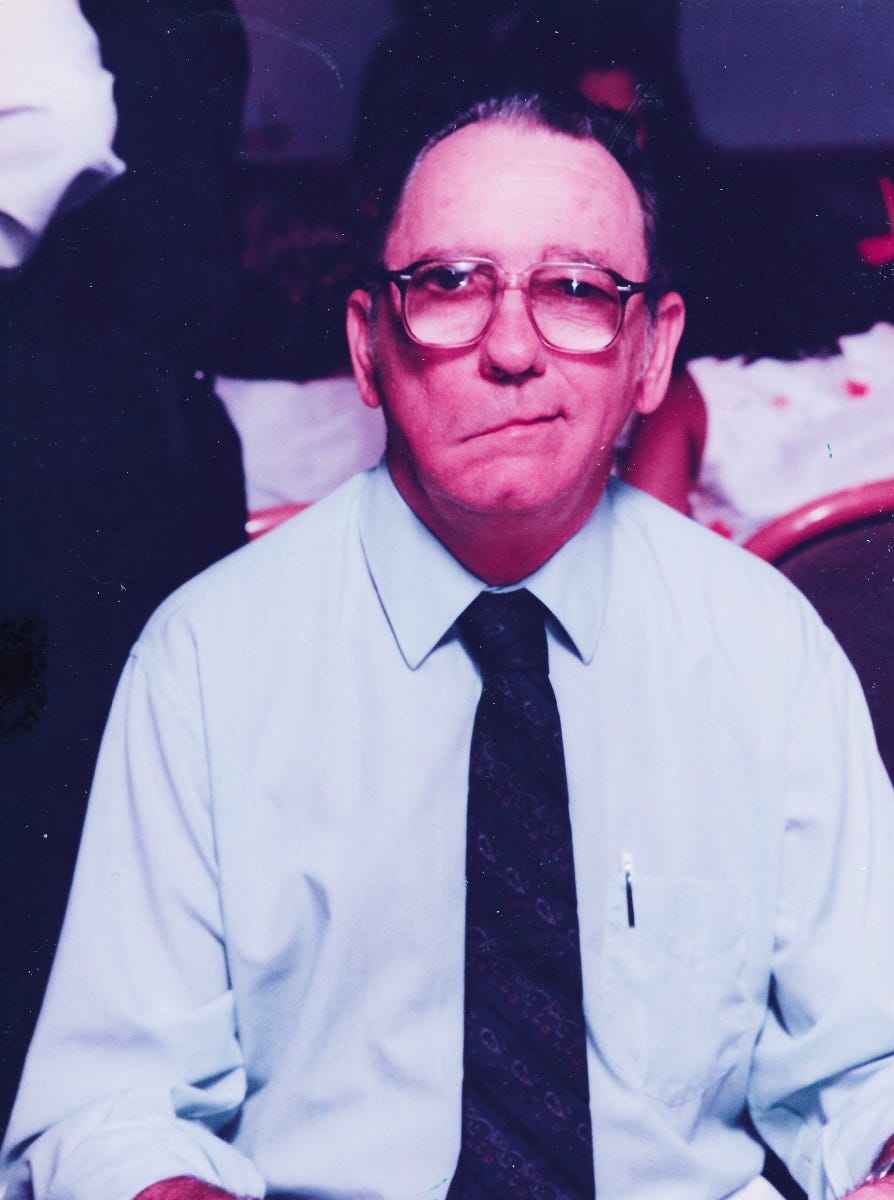
Richie came into our lives when I was about 11 years old — a striking figure on a Honda motorcycle. While I met him early in my life, it wasn’t until much later that I came to understand some of the experiences that shaped him so deeply.
He grew up in Keyport, New Jersey, entered the Air Force, and served during the Korean War as an airplane mechanic — work that left him with significant hearing loss. After his military service, he worked for many years as a machinist in New Jersey. He married my mother, Lucille, in 1973 – they’d spent the last 53 years married to each other. Then in 1980 they sold the home in which my brother Jeff and I grew up in Roselle and moved to Bradenton, Florida, starting over with new jobs and a new home. I always joked that they ran away from home.
They joined Redeemer Lutheran Church in 1981 and became active in the life of the congregation through fellowship and service. It was an interesting and unexpected turn in life for me to later become the interim minister at Redeemer — a church I had been visiting for over forty years.
Photography was one of Richie’s greatest loves, and he was a longtime member of the Suncoast Camera Club. Their home was filled with his photographs, especially beautiful wildlife shots and travel photos from the many trips he and my mother enjoyed together. One of my favorites was a photograph he took of boats along the Nile River in Egypt.
In the early 1990s, Richie underwent surgery to remove a brain tumor from his acoustic nerve, and the procedure left him with lasting stroke-like symptoms. His ability to work changed dramatically, and he was forced into early retirement. I don’t think he ever fully recovered emotionally from that loss. But once my mother retired, the two of them devoted many years to volunteering together at Blake Hospital.
In 2018, they moved here to Freedom Village, where they built strong friendships and enjoyed a full social life — card games, dinners, events, movie nights, and Friday evening entertainment. I moved to Bradenton in 2021 and often joked that they had a better social life than I did.
Even after Richie moved to the Health Center, he still would mosey over to my mother’s apartment in his electric wheelchair and spend the day with her. But even that became impossible in the last several months, limiting his world even more.
As our bodies weaken and losses accumulate, it is easy for our worlds to grow smaller. Illness can narrow our lives. Fear can narrow our lives. Hurt and disappointment can narrow our lives too. And sometimes emotional wounds we carry for decades can quietly limit our ability to give and receive love freely.
But one of the beautiful things about God’s love is that it is always trying to widen our world again — widening our compassion, widening our understanding, widening our capacity for mercy.
In the days since Richie passed, one thing that has deeply struck me has been the reaction of so many people here who cared for him during the last year and a half of his life. Several people had tears in their eyes as they offered condolences to my mother. Even young dining room staff spoke about how much they would miss him.
I think people loved his kidding spirit — the way he teased his friends and tried to make people laugh. Even when his speech became difficult to understand and he could barely hear what anyone was saying, he still wanted to bring humor and connection into the room.
I couldn’t always laugh with Richie, because my early life with him wasn’t easy. But there came a point when I knew I needed to let the past go — to forgive what had hurt me and embrace the love that was possible. I needed to find peace.
As I grew older, I came to understand that many of the things that were difficult about Richie came from hurt, fear, and limitation. His own mother abandoned him as a baby, and he also lost his beloved older brother early in life. I didn’t learn those things until well into adulthood, but that knowledge changed the lens through which I understood him.
Sometimes the people who struggle most to give love are the very people who went without it themselves.
What is undeniable is that Richie loved my mother deeply. He served his church. He volunteered faithfully. Maureen Bennett from Redeemer, who supervised his volunteer shifts at Blake Hospital, remembers how kind and supportive he was toward patients with disabilities like his own. He had many interests, many friendships, and many ways of contributing to the lives around him. Those things mattered. They were authentic parts of who he was. But so was the woundedness that shaped him.
We often come to memorial services wanting a simple story about a person. But most human beings are not simple stories. We are mixtures of love and limitation, tenderness and hurt, generosity and fear. And the beautiful thing is that the grace of God is large enough to hold all of that.
I believe most of us are doing the best we can with the lives we were handed — shaped by what we received, and sometimes by what we never received. Richie loved in the ways he knew how to love. Imperfectly, yes. But then again, so do all of us. And perhaps one of our deepest spiritual callings is to learn how to hold one another with mercy anyway.
In the Gospel of John, Jesus says, “Do not let your hearts be troubled.” Not because life is easy, but because love is stronger than fear and even death itself. In another passage from John, Martha speaks words of faith right in the middle of grief and confusion: “Yes, Lord, I believe.” And in Romans we are reminded that “whether we live or whether we die, we are the Lord’s.”
Today we gather not because a life was perfect, but because it mattered. Relationships matter. Shared years matter. Laughter, routines, photographs, teasing, companionship, and even difficult journeys all become part of the fabric of a human life.
The older I get, the more I believe that compassion is one of the holiest things we are capable of offering one another. To look beyond someone’s rough edges into the deeper story of their humanity — that is sacred work.
Jesus says, “In my Father’s house are many dwelling places.” I have always loved the wideness of that image. A home large enough for all of us. Large enough for our beauty and our brokenness. Large enough for grief, regret, gratitude, forgiveness, and love.
And perhaps that is part of what grace does throughout our lives: it keeps trying to widen us. To widen our hearts beyond resentment. To widen our vision beyond judgment. To widen our lives beyond fear.
So today, we commend Richie into the ever-widening and ever-lasting mercy of God. He loved, he was loved, and now he is held in the love of God. And that is all we can ever ask.
Amen.
Thank youn for sharing this post, Sheri to honor your stepfather. I treasure your profound take of the complexity of pain, suffering and mercy. Very pastoral. I appreciate it. harold
So moving. Thanks for sharing. I understand the dual role. I officiated funerals for mother-in-law, father-in-law and a brother-in-law. It was difficult yet an honor. 🙏